
Please ensure Javascript is enabled for purposes of website accessibility

What Is a Wood Acoustic Panel?

A wood acoustic panel is a room-treatment product designed to reduce sound reflections, not block every sound from passing through a wall. Its visible face may use slats, grooves, or perforations. Behind it, an absorptive layer and an air gap can help manage sound energy. The exact result depends on the panel’s construction, placement, and the room itself. A polished timber finish is not proof of strong acoustic performance.

Testing offers a more useful guide. ASTM C423 laboratory reports measure sound absorption and may provide a Noise Reduction Coefficient (NRC); ISO 354 specifies reverberation-room measurement methods. These results help compare products, but they do not guarantee the same outcome in every space. The World Health Organization’s Environmental Noise Guidelines describe noise as an important environmental health concern, while room treatments address a narrower problem: sound behavior indoors. Different issues, but both matter.

Sound specialist Julian Treasure has said, “Sound affects us physiologically, psychologically, cognitively and behaviorally.” His point helps explain why a wood acoustic panel is more than decoration in a busy office, classroom, or dining room. Still, panels are not magic. A few attractive slats may soften echoes, yet poor placement or a small treated area can limit the change. That detail is easy to overlook. A reliable choice starts with test data, the room’s needs, and realistic expectations.
What Is a Wood Acoustic Panel?

What Defines a Wood Acoustic Panel and Its Main Components?

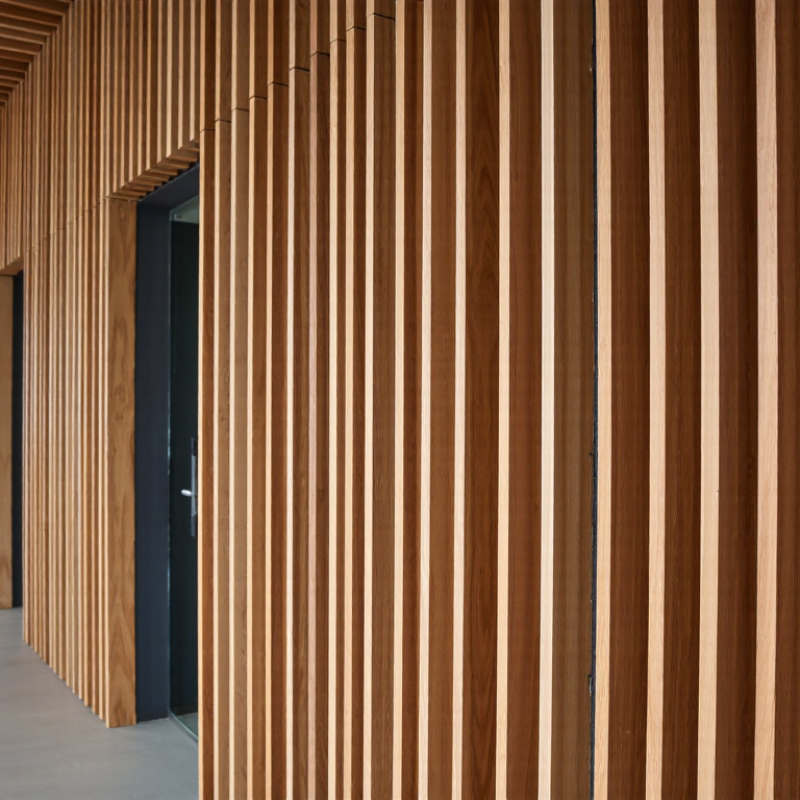
A wood acoustic panel is a wall or ceiling treatment designed to manage sound inside a room. It is not simply decorative timber. Most designs combine visible wood slats with sound-absorbing material behind them. The slats shape the surface, while the backing helps reduce sound reflections. That gap matters.

The visible layer is often made from narrow wood strips or veneered slats. Their spacing and depth affect how much of the backing remains exposed. Behind them, a layer of acoustic felt or mineral-based insulation can absorb some sound energy. A supporting board may hold the assembly together, and mounting rails or clips secure it to the wall. Each component has a job. The wood alone usually does not provide strong sound absorption.

Performance depends on more than the panel’s appearance. Backing thickness, slat spacing, and the air gap behind the panel can all influence results. Installation matters, too. A panel mounted directly to a hard wall may behave differently from one fitted over a deeper cavity. Room size and furnishings also affect what people hear. It is easy to expect any slatted surface to quiet a room, but that is not always the case. Check tested acoustic data for the complete panel system, not just the wood finish.

How Veneers, Slats, Perforations, and Backing Shape Panel Design

A wood acoustic panel combines a visible wood surface with layers designed to manage sound reflections. The veneer gives the panel its color and grain, but it does not determine acoustic performance alone. A pale oak surface may look quiet and smooth; behind it, the panel’s openings and backing do much of the acoustic work.

Veneers are usually thin, so their grain direction and finish affect appearance more than sound absorption. Slats create a repeating rhythm across the wall, with gaps that let sound reach the material behind them. Wider gaps can expose more of that layer, though the final result depends on the full assembly. Small details matter. I have seen designs where a slight change in spacing made the wall feel less uniform than expected.

Perforated panels use holes or slots to guide sound through the wood face. Hole size, spacing, and open area all influence how the panel performs, so appearance alone is a poor guide. Behind the face, felt or another porous backing helps absorb sound; a solid wall with little cavity may behave differently. Not magic. Panel placement and room surfaces matter too, and a polished veneer cannot fix every echo. I still find it tempting to judge a panel by its finish first. That is not always the useful test.

What Is a Wood Acoustic Panel? — How Veneers, Slats, Perforations, and Backing Shape Panel Design
Design Element Common Options Role in Panel Design Acoustic Considerations Practical Considerations
Wood veneer Natural wood veneer or reconstituted wood veneer applied to a stable panel surface. Provides the visible wood grain, color, and finish. Veneer is generally a thin decorative layer rather than the main sound-absorbing component. Its direct effect on sound absorption is usually limited; the perforations, cavity, and absorptive backing are more influential. Grain and color can vary between sheets. Specify the finish and veneer matching requirements for a consistent appearance.
Slats Parallel wood-faced strips with narrow or wide gaps, arranged horizontally, vertically, or in a custom pattern. Create a linear visual rhythm and leave openings through which sound can reach the material behind the slats. Slat width, gap size, and spacing affect the open area and the sound path. Slats alone should not be assumed to provide significant absorption. Consistent spacing supports a uniform appearance. Installation details should account for alignment and the panel’s supporting structure.
Perforations Round holes, slots, or other repeated openings in a wood-faced panel. Allow sound to pass through the panel face toward an air space and absorptive material behind it. Hole size, pattern, open-area ratio, panel thickness, cavity depth, and backing all affect performance. Results depend on the complete assembly. Perforation patterns influence both appearance and structural strength. Product specifications should state the pattern and tested assembly.
Backing material Acoustic fleece, mineral wool, glass wool, or other specified sound-absorbing material. Sits behind openings in the face and helps absorb sound energy within the panel assembly. Backing type, thickness, density, and position can change measured absorption. A solid, unperforated face may limit sound access to the backing. Check fire, indoor-air-quality, and installation requirements for the intended space. Do not infer performance from backing material alone.
Air cavity Small or deeper space between the panel and the wall or ceiling. Forms part of the acoustic assembly and provides room for backing material where the design requires it. Cavity depth can affect absorption, particularly at lower frequencies, but the result also depends on the face pattern and absorber. Allow for mounting hardware, services, and required clearances. Use the installation depth specified for the tested configuration.
Panel substrate Commonly a wood-based sheet material or another rigid panel core, selected for the intended construction. Supports the veneer or decorative face and provides a base for machining openings and attaching the panel. The substrate is not, by itself, a reliable indicator of sound absorption; the full panel build-up determines acoustic behavior. Consider panel thickness, weight, moisture conditions, edge treatment, and fixing method when planning installation.
Surface finish Clear or tinted coatings and other finishes suitable for the selected wood face. Protects the surface and influences sheen, color, and maintenance needs. Finish selection does not replace acoustic design. Keep openings clear and follow the panel manufacturer’s finishing guidance. Review cleaning instructions and confirm that any field-applied coating is compatible with the panel and its intended use.
Complete assembly Face, substrate, openings, backing, cavity, and mounting system considered together. Defines the finished panel’s appearance, installation method, and overall construction. Compare acoustic ratings only when the test method and assembly are identified. Laboratory results may not represent a different mounting or backing arrangement. Request project-specific test data and installation details where acoustic performance is important.
Design note: A wood acoustic panel is a decorative panel assembly designed to manage sound reflection or absorption. Its acoustic performance cannot be determined from veneer, slat spacing, or perforations alone; the complete tested construction and installation matter.

How Wood Acoustic Panels Absorb Sound Through Resonance and Porosity

What Is a Wood Acoustic Panel?

How Wood Acoustic Panels Absorb Sound Through Resonance and Porosity

A wood acoustic panel does not absorb sound simply because it is made of wood. Its slots or perforations let sound reach an air gap and porous backing. Inside that backing, moving air rubs against fine fibers, converting some sound energy into heat. The panel’s cavity can also resonate at particular frequencies, helping reduce sound around those ranges. Not magic. Panel depth, opening size, and backing material all matter.

Professional test reports using ASTM C423 list sound absorption by frequency and may report a Noise Reduction Coefficient (NRC). NRC averages results at 250, 500, 1,000, and 2,000 Hz, so it can hide differences between frequencies. ISO 354 also sets out reverberation-room measurement methods. These tests help compare assemblies, but results depend on mounting and the tested sample. A shallow panel may absorb less low-frequency sound than a deeper assembly with an air cavity; exact performance needs test data for the installed configuration.

Tips: Check octave-band results, not just the NRC. Look for the tested panel depth, backing, and air gap. A small gap behind a slatted panel can change its resonance, though it will not solve every room problem.

What Is a Wood Acoustic Panel?

How resonance and porosity help absorb sound

Illustrative absorption coefficients for a wood panel system with openings and a porous backing—not product test data. Panel openings and the air cavity can create resonance, while porous backing dissipates sound energy. Actual performance depends on panel design, mounting, and test conditions.

How ASTM C423 Rates Absorption: NRC Averages 250–2,000 Hz

A wood acoustic panel is a sound-absorbing assembly with a wood face, often slatted or perforated, and an absorptive layer behind it. Its appearance tells you little about its measured performance. The NRC offers one useful comparison.

ASTM C423 measures sound absorption in a reverberation room. For NRC, absorption coefficients at 250, 500, 1,000, and 2,000 Hz are averaged, then rounded to the nearest 0.05. These bands cover much of the speech range. NRC is not a score for every frequency. That distinction matters. A panel may absorb speech well but do less for deep bass. It also reduces reflected sound, not sound traveling through a wall.

Test results depend on details such as panel spacing, backing, and mounting method. A test specimen installed with an air gap may perform differently from a panel fixed directly to a hard surface. Check that the reported assembly matches the planned installation. In a room, coverage and placement matter too: panels near a strong reflection point can soften echoes more than the same area placed elsewhere. One number cannot capture every room. I’d treat NRC as a starting point, not a promise; real rooms are less tidy than test reports.

Where Wood Acoustic Panels Are Used and How They Are Installed

Where Wood Acoustic Panels Are Used and How They Are Installed

Wood acoustic panels are commonly fitted in living rooms, offices, meeting spaces, restaurants, and home studios. They help soften echoes caused by hard floors, glass, and bare walls. In a dining room, for example, a panel behind a table can make conversation feel less sharp. They improve room acoustics, but they do not soundproof a space or block noisy neighbors.

Installation starts with checking the wall, measuring the area, and locating studs or other suitable fixing points. Panels may be mounted with screws, clips, or adhesive, depending on their backing and the wall surface. Follow the panel maker’s fixing instructions. A level and a small spacer can help keep the slats aligned and gaps even. Small errors show.

Some installers leave an air gap behind the panels to improve sound absorption, but the result depends on the panel design and room. Plan outlets, switches, and corners before cutting anything. Use clean, accurate cuts. Still, a perfect layout on paper can look different under warm lighting, so check the arrangement on the wall before securing every panel. In damp rooms, confirm that the materials are suitable for those conditions.