
Where to Buy China Best Custom Acoustic Panels?
Choosing custom acoustic panels from China requires more than comparing prices. Performance depends on verified materials, accurate fabrication, fire safety, and installation conditions. Grand View Research reports continued growth in the global acoustic panels market, driven by offices, schools, studios, hospitality spaces, and home interiors. That growth creates opportunity. It also creates confusion.
Dr. Lily M. Wang, an acoustical engineering professor, has emphasized, “The goal of architectural acoustics is to create spaces that are acoustically appropriate for their intended use.” That principle matters when selecting custom acoustic panels. A conference room needs speech clarity. A recording studio needs controlled reflections. A restaurant needs lower background noise, not complete silence.
Reliable Chinese manufacturers should provide NRC or sound absorption data, material specifications, production photographs, and project references. Look for testing connected with recognized standards, such as ASTM C423 or ISO 354. Ask how the panel performs at different frequencies. A product may absorb mid-frequency speech while leaving bass reflections untreated.
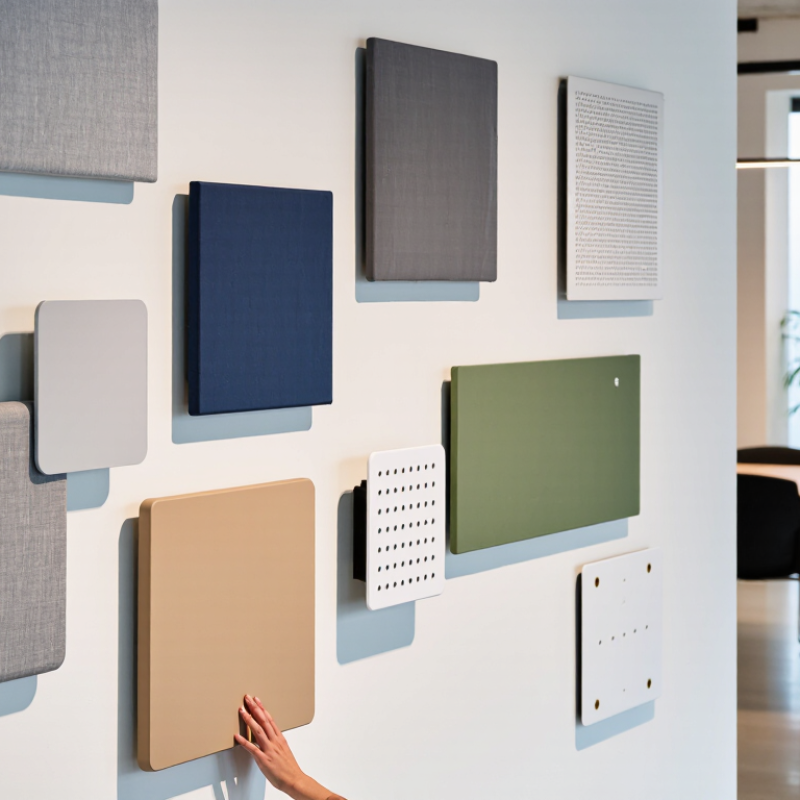
Details reveal credibility. Request a sample panel. Touch the fabric. Check the frame corners. Inspect the rear mounting system. Confirm whether dimensions, colors, edge profiles, and perforations can be customized.
One weakness remains. Laboratory results may not predict every finished room. Room shape, ceiling height, windows, furniture, and installation gaps affect performance. Therefore, the best supplier does not merely sell attractive panels. It studies the space, explains limitations, and offers measurable recommendations. That is where custom acoustic panels become a professional acoustic solution rather than decorative wall covering.
Where to Buy China Best Custom Acoustic Panels?
What Are Custom Acoustic Panels and Why Choose Chinese Manufacturers?
Custom acoustic panels are sound-absorbing products designed for a room’s reverberation, speech, and visual requirements. They commonly use mineral fiber, polyester fiber, or perforated wood. Unlike soundproof barriers, they reduce reflections rather than block every outside noise source.
The World Health Organization recommends classroom noise below 35 dB(A) during teaching hours. Its guidance also recommends bedrooms remain below 30 dB(A) at night. The European Environment Agency reported that over 113 million people in Europe faced harmful road-traffic noise exposure above 55 dB Lden. These figures show why ceiling clouds, wall panels, and baffles matter in busy interiors.
Chinese manufacturers attract buyers through flexible dimensions, surface finishes, colors, and fire-rated material options. Many can provide absorption data tested under ISO 354 or ASTM C423. Factory-direct production may also support smaller design changes, consolidated packaging, and competitive project pricing. Yet lower prices should not decide everything. Ask for test reports, substrate details, edge construction, and installation guidance. I have seen attractive samples fail because the backing was too thin or the air gap was ignored. That mistake is easy to make. Panels also cannot repair excessive HVAC noise or poor room planning. A reliable supplier should discuss reverberation targets, room volume, and mounting conditions before quoting.

Custom acoustic panels are sound-absorbing products designed with specific dimensions, shapes, colors, fabrics, and core materials to reduce reverberation and improve speech clarity. The chart below compares typical Noise Reduction Coefficient (NRC) values for commonly used panel types. Actual performance depends on thickness, mounting method, air gaps, and laboratory testing.
Chinese manufacturers are often considered for custom acoustic projects because they commonly provide flexible dimensions, broad material options, OEM production, and competitive manufacturing costs. When comparing suppliers, request laboratory acoustic-test reports, fire-safety documentation, material samples, and production-quality specifications.
Before choosing a supplier, define how the room behaves. Measure its length, width, height, and main reflective surfaces. Note hard materials, such as glass, tile, concrete, and uncovered desks. A meeting room needs clear speech, while a recording space may need wider frequency control. These goals require different panel thicknesses, shapes, and core materials.
Use a short recording to identify problems. Clapping can reveal sharp echoes, but it is not a complete acoustic test. For professional planning, check reverberation time and speech clarity. Specify the target noise environment, panel coverage, mounting method, and cleaning needs. Include exact dimensions and edge details. Fire performance and material safety should also match the project’s location and use.
Tips: Start with a simple room sketch. Mark windows, doors, lights, and air vents. Ask for test data before approving custom production. Request samples in the intended fabric and color. My first panel layout covered too much wall near the speakers and ignored the rear reflection area. It looked balanced, but the room still sounded harsh. I would now test a small arrangement before ordering the full quantity. Leave access for maintenance. Small oversights become expensive.
Where to Buy China’s Best Custom Acoustic Panels?
Reliable custom acoustic panel suppliers in China are easier to identify when evidence comes before price. A 2024 Grand View Research report projects steady growth in the global acoustic panels market, with commercial spaces remaining a major demand sector. This demand attracts capable factories and inexperienced traders. The difference is not always visible online. Ask for the factory address, production photos, material specifications, and recent project references. Then check whether the company manufactures panels or only resells them.
Request a physical sample before approving custom production. Measure its thickness, edge finish, fabric tension, and mounting hardware. For performance, review laboratory results based on ASTM C423 or ISO 354. Check the Noise Reduction Coefficient, not only the phrase “high absorption.” Fire performance also matters. EN 13501-1 or equivalent test documentation should match the actual core and fabric. Reports without laboratory details deserve caution.
A 2023 report from MarketsandMarkets also indicates rising demand for sustainable and customized acoustic materials. Ask suppliers about recycled content, formaldehyde emissions, packaging, and material traceability. ISO 9001 certification can support process control, but it does not guarantee every shipment. Use a pre-production sample and define acceptable color, size, density, and tolerance in writing. I have found that small details often expose weak quality control. Factory visits help, but they are not perfect. Production can change after inspection. Independent inspection before shipment remains a practical safeguard.
Practical comparison criteria for evaluating reliable custom acoustic panel suppliers in China
| Evaluation Dimension | Typical Industry Reference | What Reliable Suppliers Usually Provide | Recommended Verification Method |
|---|---|---|---|
| Panel Material | Polyester fiber, PET felt, fiberglass, mineral wool, wood veneer, perforated wood, and fabric-wrapped systems | Material specifications, density information, fire-performance options, edge treatments, and surface-finish samples | Request technical data sheets, physical samples, and confirmation of the material composition |
| Sound Absorption Performance | Many decorative wall and ceiling panels are designed to achieve an NRC of approximately 0.40–1.00, depending on thickness, backing, and installation | Laboratory test reports showing sound absorption results by frequency and installation condition | Check whether the test method follows recognized standards such as ASTM C423 or ISO 354 |
| Available Thicknesses | Common thicknesses include 9 mm, 12 mm, 15 mm, 20 mm, 24 mm, 25 mm, 40 mm, and 50 mm | Standard thicknesses plus customized thickness, edge, groove, and backing solutions | Compare the approved drawing with the final production sample before mass manufacturing |
| Custom Shapes and Sizes | Rectangular, hexagonal, baffle, cloud, curved, slatted, carved, printed, and CNC-cut designs are commonly available | CAD or technical drawing support, CNC cutting, pattern matching, and installation layout planning | Send a dimensioned drawing and request a production-ready shop drawing for approval |
| Fire Performance | Fire classifications vary by material and market; commonly requested references include ASTM E84, EN 13501-1, and GB 8624 | Material-specific fire-test documentation and clear identification of the tested construction | Confirm that the report applies to the exact material, thickness, surface finish, and assembly being purchased |
| Moisture and Environmental Resistance | PET and polyester panels are generally suitable for dry interior spaces; special areas may require additional protection | Guidance on humidity limits, cleaning methods, stain resistance, and suitable application areas | Ask for written installation and maintenance instructions before selecting the material |
| Surface Finish and Color | Fabric, PET felt, veneer, laminate, paint, printed graphics, and customized color matching are widely used | Color cards, finish samples, batch-control procedures, and guidance on color variation | Approve a physical color sample rather than relying only on digital images |
| Minimum Order Quantity | Standard products may have lower minimum quantities, while custom colors, molds, printing, and special profiles may require higher quantities | Clear quantity requirements for samples, trial orders, standard production, and customized production | Obtain a written quotation showing minimum quantities for every customized component |
| Sample Development | Basic material samples are often available quickly; custom shapes, printing, and assemblies require additional development time | Pre-production samples, color approval samples, packaging samples, and revision management | Use a signed sample or approved digital specification as the quality reference |
| Typical Production Lead Time | Standard items commonly require about 15–25 working days; complex custom orders may require approximately 25–45 working days after approval | Production schedules that identify sampling, material preparation, manufacturing, inspection, and packing stages | Confirm the lead time in the purchase contract and define the approval date clearly |
| Quality Control | Important checks include dimensions, color consistency, surface defects, panel flatness, cutting accuracy, packaging, and quantity | Incoming-material inspection, in-process inspection, final inspection, and photographic records before shipment | Request a pre-shipment inspection or appoint an independent inspection service |
| Installation System | Common methods include adhesive, clips, Z-clips, suspension cables, metal frames, and concealed mounting systems | Installation drawings, hardware lists, panel numbering, and project-specific layout recommendations | Verify wall or ceiling conditions, fire requirements, access needs, and replacement procedures |
| Packaging and Export Protection | Panels are commonly protected with plastic film, foam, corner protection, cartons, pallets, or reinforced export crates | Moisture protection, drop-resistant packing, palletization, carton labels, and loading photographs | Approve the packaging specification and confirm whether the packing is suitable for sea or air transport |
| Export Documentation | Typical documents include commercial invoices, packing lists, shipping documents, certificates of origin, and test reports when required | Accurate product descriptions, harmonized tariff information, shipment records, and customs-support documents | Provide the destination-country import requirements before production and shipping |
| Sustainability Information | Recycled PET content, low-emission materials, recycled packaging, and environmental product documentation may be available | Recycled-content declarations, VOC information, environmental certificates, and material traceability where applicable | Check whether sustainability claims are supported by third-party documentation |
| Warranty and After-Sales Support | Commercial warranty periods vary by supplier and product; written terms are essential for customized orders | Defined coverage for manufacturing defects, color issues, delamination, replacement parts, and claim procedures | Review warranty exclusions, claim deadlines, installation responsibilities, and replacement arrangements |
| Commercial Terms | Common quotation terms include EXW, FOB, CIF, and DDP, depending on the project and destination | Itemized pricing for panels, accessories, tooling, samples, packaging, freight, and taxes | Compare quotations using the same specifications, delivery terms, currency, and payment conditions |
| Supplier Reliability Indicators | Consistent technical communication, documented quality procedures, transparent pricing, stable lead times, and complete project references | Clear answers, traceable documents, realistic production commitments, and willingness to provide samples before ordering | Evaluate several suppliers using the same request-for-quotation document and scoring criteria |
Note: Lead times, minimum order quantities, performance values, certifications, and warranty terms vary according to the panel material, design complexity, order volume, installation system, and destination market. Always verify project-specific information before placing an order.
Choosing a Chinese supplier requires more than comparing catalog photos. Request an absorption report tested under ISO 354 or ASTM C423. These tests show how panels perform across frequencies, not only at 1,000 Hz. Look for NRC or weighted absorption values, thickness, density, edge treatment, and mounting details. A panel can look excellent and still perform poorly in a real meeting room. I have seen this mismatch before. Samples matter.
Customization should solve an acoustic problem, not merely change color. Ask for drawings, fire classification, VOC information, and production tolerances. ISO 11654 can support absorption classification, while relevant fire testing supports safer commercial use. Certifications should be traceable to the factory and product version. Generic certificates are weak evidence. Very weak.
Pricing needs a full comparison. Include tooling, fabric upgrades, printing, packaging, shipping, installation, and replacement panels. The cheapest quotation often hides these costs. The World Health Organization’s 2018 environmental noise report recommends indoor bedroom levels below 30 dB(A) at night. Meanwhile, the European Environment Agency’s 2020 report estimated that road noise chronically annoys more than 22 million Europeans. These figures show why acoustic control deserves measurable targets. Ask suppliers to model reverberation time before ordering. Still, predictions are imperfect. Room furniture, ceiling height, and installation gaps can change the result. A reliable supplier admits that uncertainty.
Where to Buy China Best Custom Acoustic Panels?
Choosing a Chinese supplier requires more than comparing prices. Check factory experience, production capacity, and documented acoustic performance before ordering. Ask for test reports showing sound absorption ratings, frequency ranges, and testing conditions. Product photos are useful, but they do not prove performance.
Request a physical sample before approving large quantities. Inspect the fabric, panel edges, mounting hardware, and color consistency. Measure the sample in your actual room if possible. A panel that looks excellent online may feel too thin or fragile in person. I once underestimated packaging quality, and several corners arrived damaged. That mistake changed how I review export orders.
Tips: Confirm panel dimensions, minimum order quantities, lead times, and replacement policies in writing. Ask how panels are protected from moisture during shipping. Verify carton labels, packing lists, invoices, and other import documents before dispatch. Check applicable fire-safety and building requirements in your destination market. Compare shipping terms carefully, because a low product price can hide expensive freight or handling charges. Keep communication records. Small details matter.