

What Are the Top Soundproofing Materials for Buyers?
Choosing soundproofing materials is less about buying the thickest panel and more about controlling how noise travels. A wall, floor, or ceiling behaves as a system: gaps leak sound, lightweight surfaces vibrate, and soft furnishings mainly reduce room echo. Small details matter. A sealed door perimeter can be more useful than decorative foam on a wall.
The World Health Organization’s 2011 report, Burden of disease from environmental noise, estimated that traffic noise caused at least one million healthy life-years to be lost annually in Western Europe. Its 2018 Environmental Noise Guidelines also identify noise exposure as a public-health concern. These reports do not rank insulation products, but they explain why buyers should consider measured performance, installation quality, and the noise source—not marketing claims alone. Look for test data, such as laboratory sound-transmission ratings, and check that the tested assembly resembles your own wall or floor.
Architectural acoustics researcher Dr. Lily M. Wang’s work supports a systems-based approach. A concise summary of that principle—not a verbatim quotation—is: “Effective noise control depends on the whole assembly, not one miracle material.” That distinction helps compare mineral wool, resilient channels, acoustic sealants, and mass-loaded barriers more realistically. Some products absorb sound inside a cavity; others limit vibration or block transmission. They are not interchangeable. And results can disappoint when installation leaves even narrow gaps. That part is easy to underestimate.
This guide compares leading options by use, performance evidence, and practical trade-offs, helping buyers choose materials suited to real rooms, budgets, and noise problems.
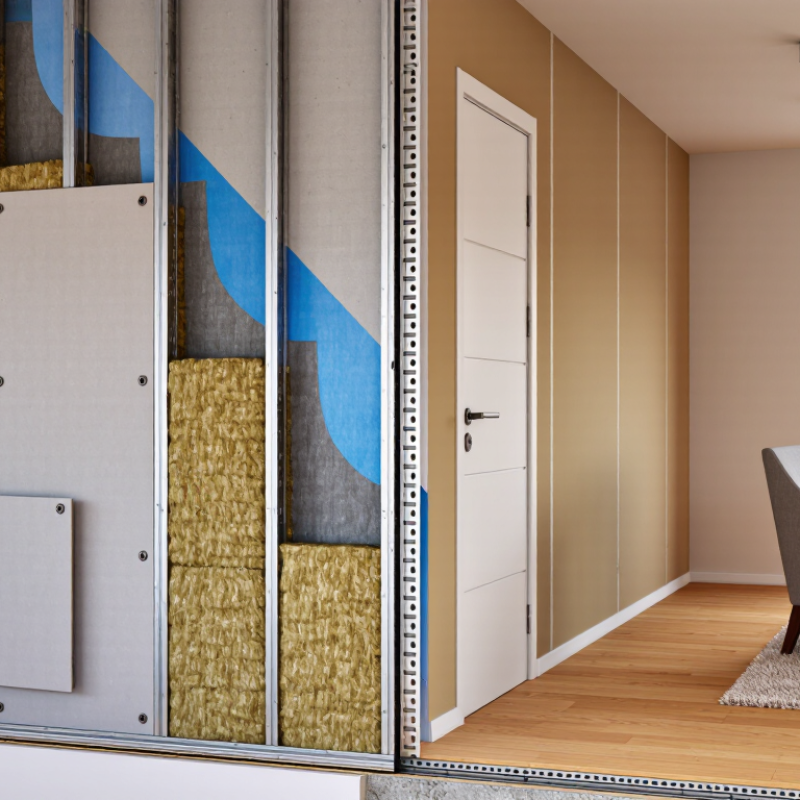
Understanding Soundproofing Materials and How They Work
Soundproofing works by reducing sound transmission, not simply by making a room “quiet.” Sound travels through air, but it also vibrates walls, floors, and framing. Effective designs usually combine mass, absorption, airtightness, and separation. No single material does all four.
Dense drywall adds mass to a wall, while mineral wool or fiberglass in a cavity absorbs sound energy and limits resonance. These soft materials help, but they are not sound barriers on their own. That distinction matters. Resilient channels or isolated framing can reduce vibration passing between wall layers. Acoustic sealant closes small gaps around outlets, trim, and pipe openings; even a narrow crack can weaken an otherwise solid assembly. Gaps are costly.
The best choice depends on the noise and the existing structure. Voices through a shared wall may respond to added mass, cavity insulation, and careful sealing. Footsteps from above often need impact control at the floor, not just thicker walls. Low-frequency noise is harder to manage, and sound can travel around an upgraded wall through ceilings or adjoining rooms. It is tempting to buy one “acoustic” panel and expect silence. That is rarely realistic. Measure where sound enters, inspect the edges, and treat the whole path where practical. Performance also depends on installation, so check product claims against tested assembly results, not material names alone.
What Are the Top Soundproofing Materials for Buyers? — Understanding Soundproofing Materials and How They Work
| Material | How It Works | Best For | Typical Installation | Buyer Considerations |
|---|---|---|---|---|
| Mineral Wool or Fiberglass Batts | Absorbs sound energy inside a cavity, reducing resonance within walls, floors, and ceilings. It does not block sound effectively when used alone. | Filling stud or joist cavities in interior partitions and ceilings. | Fit between framing members without compressing the batts; cover with a finished wall or ceiling layer. | Choose a product sized for the cavity. Airtightness and the surrounding wall assembly strongly affect the final result. |
| Additional Gypsum Board | Adds mass to a wall or ceiling, making it harder for airborne sound to set the surface vibrating. | Improving existing wall or ceiling assemblies, especially when combined with cavity absorption and sealed edges. | Add one or more layers to framing or to a compatible resilient-channel system; seal perimeter gaps. | Added weight requires suitable framing and fasteners. More layers alone may have limited effect if sound bypasses the assembly through gaps or structural connections. |
| Resilient Channels or Isolation Clips | Decouple the finished surface from framing, reducing the direct transmission of vibration through the structure. | Walls and ceilings where structural sound transmission is a concern. | Install according to the system layout, then attach the specified board without short-circuiting the isolation. | Installation details matter: incorrect fasteners or contact with framing can reduce isolation. Follow the tested assembly instructions. |
| Mass-Loaded Vinyl | Adds flexible mass to an assembly to help reduce airborne sound transmission. | Selected walls, ceilings, doors, or equipment enclosures where a thin, flexible barrier is useful. | Hang or sandwich it within an assembly, with seams and edges carefully sealed. | It is not a substitute for a complete wall or ceiling system. Check product weight, fire requirements, and compatibility with the installation. |
| Acoustic Sealant | Closes small air gaps that can let sound leak around an otherwise substantial assembly. | Perimeters, joints, electrical-box edges, and penetrations in sound-treated walls or ceilings. | Apply continuously at appropriate joints before they are concealed; use a sealant intended for the application. | Sealant complements mass and isolation rather than replacing them. Maintain required fire and building-code details. |
| Acoustic Door Seals and Door Sweeps | Reduce sound leakage through gaps around and beneath a door. | Room entrances, offices, bedrooms, and other spaces where a door is the weak point. | Fit perimeter seals and an adjustable sweep or threshold so the door closes with minimal gaps. | A solid door and a well-sealed frame generally perform better than a lightweight, poorly fitted door. Check that the door still operates freely. |
| Acoustic Panels | Absorb reflections within a room, reducing echo and reverberation; they generally do not provide substantial sound isolation through a wall. | Improving speech clarity and reducing room echo in offices, studios, and shared spaces. | Mount panels on room surfaces, with placement guided by the room’s reflective areas. | Compare tested absorption data, such as NRC, at the relevant thickness and mounting method. Do not treat NRC as a measure of blocking sound between rooms. |
| Acoustic Foam | Absorbs some mid- and high-frequency reflections at the surface; it has little mass for blocking sound transmission. | Controlling room reflections in suitable recording or listening spaces. | Attach to interior surfaces using a compatible mounting method and follow fire-safety guidance. | Foam does not soundproof a wall. Performance depends on its profile, thickness, frequency, and installation. |
Selection note: Sound isolation depends on the complete assembly, including its mass, cavity absorption, decoupling, airtightness, and flanking paths. Product-level ratings are not directly interchangeable; compare tested assemblies under relevant standards and local building requirements.
Related Posts
-
What Is the Best Sound Proofing Material from China?
-
China Top Sound Proofing Material Suppliers
-

How to Choose Soundproofing Materials for Global Sourcing?
-
China Top Sound Dampening Manufacturers How to Choose?
-

Unlocking the Secrets of Sound Dampening Techniques for a Quieter Home Environment
-

2026 How to Sound Proof Your Home Effectively?