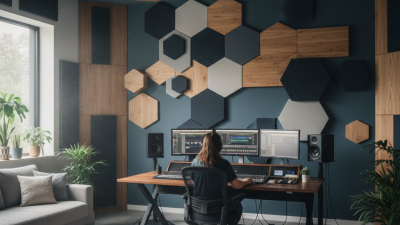

Choosing Soundproofing materials for global sourcing requires more than comparing prices and thicknesses. A supplier’s product may look impressive in a catalog, yet perform differently in a real room. Sound travels through walls, floors, doors, ventilation paths, and small construction gaps. This is why buyers should examine the complete acoustic system, not one isolated product.
Experienced sourcing teams begin with the noise problem. Is the project reducing traffic noise, machinery vibration, voices, or airborne sound? Each source requires a different approach. Dense acoustic panels can reduce sound transmission. Resilient channels can limit structural vibration. Sealing compounds can close narrow gaps around frames and joints. The correct combination often matters more than a single high-rated material.
Performance evidence should guide purchasing decisions. Request laboratory reports, installation instructions, technical data sheets, and consistent batch information. Check whether tests reflect the intended wall, ceiling, or floor assembly. International projects may also require review of fire performance, chemical safety, durability, and local building requirements. Standards help, but they do not remove every risk.
No material is perfect. A cheaper product can create higher costs when installation fails. A premium product can disappoint when the surrounding structure is weak. This point is easy to overlook. Supplier audits, sample testing, and small trial installations can reveal problems before large shipments begin. Buyers should also confirm packaging quality, moisture protection, lead times, and after-sales support. Reliable Soundproofing sourcing depends on measurable performance, practical installation, and honest communication across borders. Sometimes, the best decision is not the most advanced material, but the one that workers can install correctly and consistently.
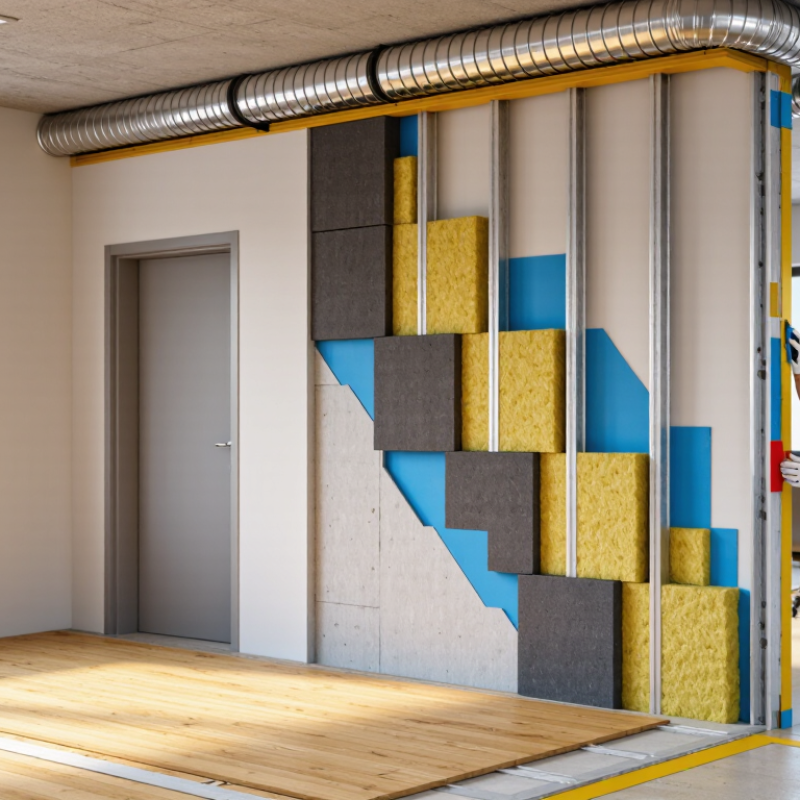
Before choosing soundproofing materials, define the noise problem precisely. Is the target speech, traffic, machinery, or impact from footsteps? Each source needs a different control strategy. Record the room’s size, wall structure, openings, and nearby equipment. A quiet office may require speech privacy, while a factory may need protection from continuous low-frequency vibration. Do not rely on the word “soundproof.”
Set measurable performance requirements. Specify a reduction target in decibels, the main frequency range, and the test method. Ratings such as STC or Rw can help, but they do not describe every real-world sound. Low-frequency noise may still pass through a partition with a strong rating. Ask suppliers for independent laboratory reports, installation details, and test conditions. Compare equivalent documents, not attractive marketing claims.
Global sourcing adds practical risks. Check fire behavior, moisture resistance, indoor emissions, density, thickness, and expected service life. A material that performs well in a dry laboratory may fail in a humid warehouse. Request small samples and build a trial panel with the proposed framing, seals, fasteners, and surface layers. Measure results before placing a large order. This step costs time, but replacement shipments cost more. I would also question unusually high claims; they may reflect ideal installation rather than everyday performance. The weak point is often the joint around a door, pipe, or cable.
Choosing soundproofing materials for global sourcing requires comparing acoustic properties, not just thickness or price. Absorption reduces reflections inside a room. Isolation blocks sound passing through walls, floors, and ceilings. They are different jobs.
For absorption, check the Noise Reduction Coefficient, or NRC, tested under ASTM C423. NRC averages absorption at 250, 500, 1,000, and 2,000 Hz. Fiberglass and mineral wool panels often achieve NRC values around 0.70–1.10 in laboratory reports. Higher values usually indicate stronger speech-frequency absorption. Foam may perform well at mid and high frequencies, but thin foam often struggles with bass. That distinction matters.
For isolation, request sound transmission loss data under ASTM E90 or ISO 10140. A wall’s Sound Transmission Class, or STC, belongs to the complete assembly, not one material. Mass-loaded vinyl can add density, while gypsum layers and resilient channels improve separation. However, weak joints can reduce real-world performance sharply. The World Health Organization’s 2018 Environmental Noise Guidelines recommend indoor bedroom noise below 30 dB(A) at night. Small gaps can undermine that goal.
Global suppliers should provide frequency curves, laboratory conditions, thickness, density, fire classification, and installation details. Compare low-frequency results carefully. Real rooms are messier. I would not trust a single headline rating without test documentation and independent verification.
| Material | Primary Acoustic Function | Typical Thickness | Typical Density | α at 125 Hz | α at 250 Hz | α at 500 Hz | α at 1,000 Hz | α at 2,000 Hz | α at 4,000 Hz | Approx. NRC | Best Sourcing Use |
|---|---|---|---|---|---|---|---|---|---|---|---|
| Mineral Wool Board | Porous sound absorption | 50–100 mm | 40–100 kg/m³ | 0.20–0.35 | 0.55–0.85 | 0.85–1.05 | 0.90–1.10 | 0.90–1.10 | 0.85–1.05 | 0.75–1.00 | Wall, ceiling, studio, and equipment-room absorption systems |
| Fiberglass Acoustic Board | Porous sound absorption | 25–100 mm | 25–100 kg/m³ | 0.15–0.35 | 0.45–0.80 | 0.80–1.05 | 0.90–1.10 | 0.90–1.10 | 0.85–1.05 | 0.70–1.00 | Acoustic panels, suspended ceilings, HVAC enclosures, and partitions |
| Polyester Fiber Panel | Porous sound absorption | 9–50 mm | 150–250 kg/m³ | 0.05–0.15 | 0.15–0.35 | 0.35–0.65 | 0.60–0.90 | 0.75–1.00 | 0.80–1.00 | 0.45–0.85 | Decorative wall panels, offices, classrooms, and public interiors |
| Open-Cell Acoustic Foam | Mid- and high-frequency absorption | 25–100 mm | 20–60 kg/m³ | 0.05–0.15 | 0.15–0.35 | 0.45–0.75 | 0.70–0.95 | 0.80–1.00 | 0.85–1.05 | 0.40–0.80 | Recording rooms, broadcast spaces, machinery enclosures, and echo control |
| Melamine Foam | Lightweight porous absorption | 25–75 mm | 8–15 kg/m³ | 0.05–0.20 | 0.20–0.45 | 0.55–0.85 | 0.75–1.00 | 0.85–1.05 | 0.85–1.05 | 0.50–0.85 | Weight-sensitive interiors, transport equipment, and industrial acoustic treatment |
| Mass-Loaded Vinyl | Flexible airborne-sound barrier | 1.5–3 mm | 1,500–2,000 kg/m³ | 0.00–0.05 | 0.00–0.05 | 0.00–0.05 | 0.00–0.05 | 0.00–0.05 | 0.00–0.05 | 0.00–0.05 | Floor, wall, ceiling, vehicle, and equipment assemblies requiring added mass |
| Gypsum Board | Rigid mass barrier and partition layer | 12.5–15 mm per layer | 600–900 kg/m³ | 0.05–0.10 | 0.05–0.10 | 0.05–0.10 | 0.05–0.10 | 0.05–0.10 | 0.05–0.10 | 0.05–0.10 | Wall and ceiling systems when combined with cavities, insulation, and resilient supports |
| Plywood or OSB Panel | Rigid structural mass layer | 12–25 mm | 500–700 kg/m³ | 0.10–0.20 | 0.10–0.15 | 0.05–0.10 | 0.05–0.10 | 0.05–0.10 | 0.05–0.10 | 0.05–0.10 | Structural wall, floor, and enclosure assemblies requiring stiffness and mass |
| Rubber or EPDM Isolation Pad | Vibration isolation and resilient decoupling | 3–25 mm | 900–1,400 kg/m³ | 0.00–0.05 | 0.00–0.05 | 0.00–0.05 | 0.00–0.05 | 0.00–0.05 | 0.00–0.05 | 0.00–0.05 | Machinery mounts, floating floors, resilient channels, and impact-noise control |
Data note: The absorption coefficients are representative ranges for commonly used product constructions measured under laboratory conditions. Actual values vary with thickness, density, mounting method, air gaps, surface finish, and test standard. The approximate NRC is calculated from absorption values at 250, 500, 1,000, and 2,000 Hz and should be verified using project-specific test reports.
Material safety should be checked before price or acoustic performance. Request current test reports for fire behavior, VOC emissions, moisture resistance, and formaldehyde levels. These documents should identify the tested product, method, date, and laboratory. A supplier’s general certificate may not represent the material you receive. Check local building requirements in the destination market. Safety expectations can differ between countries.
Durability depends on the installation environment. A ceiling panel in a dry office faces different risks than a wall liner near machinery. Examine resistance to humidity, temperature changes, compression, dust, and surface damage. Ask for aging data when available. Inspect samples after transport, not only before shipment. Small dents can become visible across a large wall. No material is perfect. I would record weaknesses instead of hiding them. That record supports more honest purchasing decisions.
Tips: Test a small installation first. Confirm panel weight, cutting tools, adhesive compatibility, fixing methods, and replacement access. Measure the substrate carefully. Uneven walls may require additional framing or adjustment. Installation instructions should use clear drawings and realistic tolerances. Ask whether workers need protective equipment during cutting or handling. Keep spare pieces for future repairs. Fit matters. A material with strong laboratory results may perform poorly when gaps, loose joints, or incorrect fasteners reduce its acoustic seal.
Global sourcing starts with the correct performance evidence. Ask for laboratory reports showing sound transmission loss, absorption ratings, fire behavior, and VOC emissions. These figures should match the intended wall, ceiling, floor, or equipment application. A material with high absorption may not block noise effectively. Check the test method, laboratory accreditation, sample thickness, and test date. Standards can differ between markets, so compare equivalent methods before approving a sample.
Tips:
Request certification copies, not only certificate numbers. Verify the issuing body and certification scope. Review ISO 9001 for quality management and ISO 14001 for environmental controls when relevant. For construction materials, confirm applicable regional fire and emissions requirements. Certificates can expire. Test reports can also describe a different product. This detail is easy to miss.
Supplier reliability requires more than a polished factory presentation. Examine batch records, incoming inspection procedures, packaging strength, and corrective-action history. Ask for three production samples from different lots. Compare density, dimensions, surface finish, and measured performance. A supplier should explain tolerance limits clearly. Conduct a remote or independent factory audit when order value justifies it. No checklist is perfect. I would still keep a small pilot order, because production quality may change under pressure. Use written specifications, approved samples, inspection points, and a response deadline for nonconformities. This creates evidence, not just promises.
How to Choose Soundproofing Materials for Global Sourcing?
Global sourcing should begin with total cost, not the factory quotation. UNCTAD’s Review of Maritime Transport 2023 states that over 80% of global merchandise trade by volume moves by sea. Freight, insurance, customs handling, and port storage can therefore change the final price sharply. The 2024 State of Logistics Report estimated U.S. business logistics costs at 8.7% of GDP in 2023. That figure is not a universal benchmark, but it shows logistics is too large to ignore. I request quotes based on delivered cost, including pallets, container utilization, damage rates, and local installation.
Material performance also affects long-term value. Compare sound transmission loss, thickness, density, moisture resistance, and fire classification. A lightweight panel may reduce freight charges, yet require extra layers on site. An acoustic test report should identify the test standard, frequency range, and laboratory conditions. Without those details, impressive numbers can mislead. I have seen buyers compare one product’s laboratory result with another product’s field result. It looked precise. It was not.
Tips: Order samples before full production. Weigh each packed unit. Calculate cost per treated square meter, not cost per sheet. Add a 5–10% contingency for transit damage and installation waste. Recheck the calculation after currency changes. The first spreadsheet is rarely perfect.