

What Are the Best Acoustic Art Panels from China?
Choosing the best acoustic art panels from China requires more than admiring attractive prints. It means examining how each panel performs in a real room. A lively restaurant, recording studio, hotel lobby, and home office need different acoustic solutions. Panel thickness, core density, fabric openness, perforation design, and installation spacing can change the result. Even the wall behind the panel matters.
Julian Treasure, a respected sound consultant and author, once said, “We are losing our listening.” That warning fits this topic. Decorative panels should not merely cover echoes. They should help people hear conversations, music, and important announcements more comfortably. In my experience reviewing acoustic products, a beautiful image can hide weak sound absorption. This is where careful product evidence becomes essential. Look for laboratory test reports, absorption ratings, fire-performance information, and clear manufacturing details. Ask whether the reported results follow recognized testing methods, such as ISO or ASTM procedures. Supplier claims alone are not enough.
China offers a broad range of acoustic art panels, from printed PET felt tiles to framed fabric absorbers and custom ceiling systems. Some manufacturers provide excellent color accuracy and consistent edge finishing. Others need closer quality control. The best choice depends on measured performance, visual requirements, budget, and after-sales communication. Not every popular panel is suitable. That is easy to forget.
A thoughtful comparison should also consider shipping protection, installation instructions, replacement options, and environmental documentation. Small details matter. A damaged corner can ruin an otherwise refined wall. This guide will examine these factors and identify practical choices for different spaces, while acknowledging one uncomfortable truth: no single panel works perfectly everywhere.
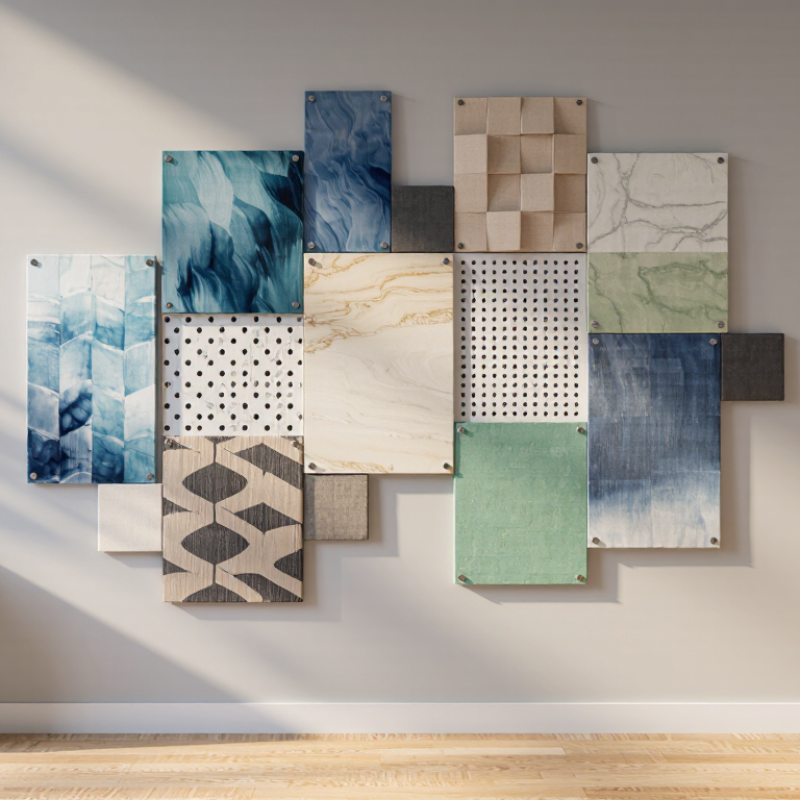
What Are Acoustic Art Panels and How Do They Improve Interior Acoustics?
Acoustic art panels combine sound absorption with visual design. They usually use recycled polyester, mineral fiber, or fabric-covered cores. Printed surfaces can display landscapes, geometric forms, or custom images. These panels are not soundproof barriers. They reduce reflections inside a room.
In practice, panels soften speech, music, and mechanical noise. They are useful in offices, restaurants, studios, classrooms, and home theaters. Hard walls create sharp echoes. A properly placed panel catches part of that reflected energy. Conversations then feel clearer. The room sounds calmer. Results depend on thickness, density, surface coverage, and installation height. Thin decorative panels may improve high frequencies but leave low bass almost unchanged. That limitation is easy to miss. Room measurements or an acoustic consultant can prevent expensive guesswork.
Tips: Choose panels with independent absorption data, such as NRC or equivalent test results. Check the backing material and local fire-safety requirements. Place panels near strong reflection points, especially beside speakers and across from hard walls. Leave small air gaps when suitable; they can improve absorption. For products made in China, request samples, test documents, color proofs, and packaging details before ordering. Compare workmanship carefully. Attractive printing cannot replace reliable acoustic performance.
What Are the Best Acoustic Art Panels from China? – What Are Acoustic Art Panels and How Do They Improve Interior Acoustics?
| Panel Type | Typical Core or Surface | Common Thickness | Indicative Sound Absorption | Best Interior Applications | Key Advantages |
|---|---|---|---|---|---|
| Printed PET Felt Art Panel | Recycled or virgin polyester fiber with a digitally printed, laminated, or directly applied decorative surface | 9–24 mm | Typically NRC 0.30–0.75, depending on thickness, air gap, and installation | Offices, classrooms, corridors, restaurants, reception areas, and creative workspaces | Lightweight, visually customizable, easy to cut, and generally resistant to fiber shedding |
| Fabric-Wrapped Absorber with Printed Artwork | Fiberglass, mineral wool, or polyester core covered with acoustically transparent fabric and printed graphics | 25–100 mm | Typically NRC 0.70–1.00 for thicker panels with suitable mounting conditions | Meeting rooms, auditoriums, studios, hospitality spaces, and open-plan offices | High mid- and high-frequency absorption with strong possibilities for large-format artwork |
| Perforated Wood Acoustic Art Panel | Perforated or slotted MDF, plywood, or wood veneer backed by an absorptive layer and air cavity | 16–50 mm, excluding the air gap | Typically NRC 0.45–0.85; performance depends strongly on perforation ratio and backing | Libraries, boardrooms, cultural venues, restaurants, and premium residential interiors | Combines acoustic treatment with a natural wood appearance and durable decorative finish |
| Microperforated Decorative Panel | Thin wood, metal, or polymer face with precisely sized micro-openings and an enclosed air cavity | 1–10 mm face layer plus cavity | Often NRC 0.30–0.70, with absorption tuned by hole size, spacing, cavity depth, and damping material | Museums, galleries, luxury interiors, media rooms, and spaces requiring a clean surface | Slim visual profile and the ability to integrate acoustic treatment into decorative wall systems |
| Acoustic Wood-Wool Art Panel | Wood fibers bonded with mineral binder, sometimes finished with colored paint or a printed decorative layer | 15–50 mm | Typically NRC 0.45–0.90, depending on density, thickness, and mounting configuration | Schools, commercial interiors, music education spaces, offices, and public buildings | Textured appearance, impact resistance, and broad-area reverberation control |
| Ceiling-Mounted Acoustic Art Cloud | PET felt or fabric-wrapped absorptive panel suspended horizontally or vertically from the ceiling | 12–50 mm panel, typically installed with an open air gap | Effective absorption commonly equivalent to NRC 0.70–1.10 under appropriate laboratory or field conditions | Open-plan offices, cafeterias, atriums, studios, and rooms with hard ceilings | Treats ceiling reflections while preserving wall area for artwork, storage, or glazing |
Related Posts
-
What Are the 2026 Top Types of Decorative Acoustic Panels?
-
How to Choose the Best Acoustic Tiles?
-
Best Decorative Acoustic Panels for Global Buyers?
-
2025 How to Choose the Best Acoustic Sound Panels for Your Home Studio
-
What Are Custom Acoustic Panels and How Do They Work?
-
Why Choose Sound Panels for Walls for Better Acoustics?