How to Choose a Solid State Diode Laser in 2026
Choosing a Solid State Diode Laser in 2026 starts with the job it must perform, not the highest power figure on a product page. Is the system cutting, sensing, pumping another laser, or delivering light through a fiber? Each use favors different wavelengths, beam quality, pulse formats, and cooling methods. Theodore Maiman, the laser pioneer, is often credited with the line, “The laser is a solution looking for a problem.” It remains a useful warning: impressive specifications do not guarantee a useful match.
Check the wavelength against the material or detector, then compare optical output with the required spot size and working distance. Look for beam-quality data, such as M², and ask whether the quoted power is continuous-wave or pulsed. They are not interchangeable. Thermal management matters, too. A compact head may still need a substantial heat sink, stable current driver, and clear airflow around its housing. Small details matter.
Reliability claims deserve scrutiny. Ask how operating life was measured, under what temperature, and at what drive current. Review the warranty, service options, and documentation before choosing a supplier. If possible, test a sample in the actual setup; a clean laboratory reading may not survive vibration, dust, or long operating shifts. One caveat: “solid state diode laser” can describe products with different architectures, so confirm what the vendor means. The datasheet is a starting point, not a verdict. That deserves a second look. A careful choice balances performance, integration, safety controls, and support—not just price or peak power.
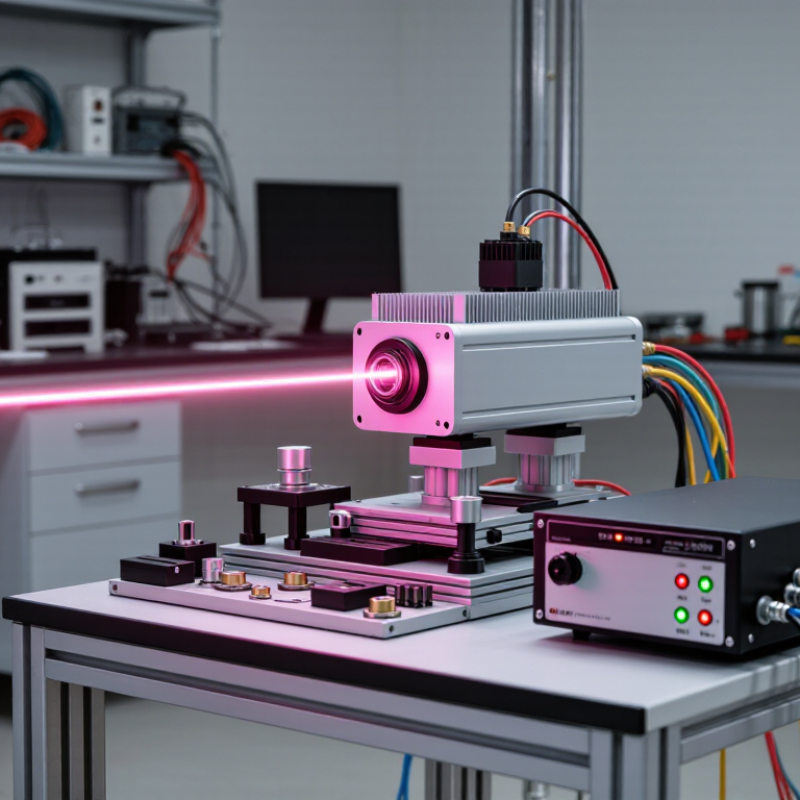
Define Solid State Diode Lasers and Their 2026 Applications
How to Choose a Solid State Diode Laser in 2026
A solid-state diode laser uses semiconductor diodes to create or excite laser light within a solid gain medium, such as a crystal. The term can describe different designs, so check the exact architecture before comparing equipment. A direct diode laser emits light from semiconductor diodes; a diode-pumped solid-state laser uses them to energize another material. The difference affects wavelength, beam quality, efficiency, and maintenance.
In 2026, these systems serve precision manufacturing, medical and dental equipment, scientific instruments, and measurement tools. In a factory, a focused beam may mark a small component or process a narrow seam. In a laboratory, stable output can support spectroscopy or precise measurements. Requirements vary. A compact unit may suit limited bench space, while continuous industrial use calls for careful attention to cooling and service intervals. Small details matter. Even a good specification can disappoint if the beam profile does not fit the task.
Tips: Start with the application, then compare wavelength, output power, beam quality, and operating mode. Ask for test data under realistic conditions, not just ideal laboratory figures. Check cooling needs, expected maintenance, and safety controls. Leave room for doubt: published performance may not match your actual setup.
How to Choose a Solid-State Diode Laser in 2026
Diode lasers generate light in a semiconductor junction. In diode-pumped solid-state (DPSS) lasers, diode light pumps a solid gain medium, such as a crystal. The chart shows common wavelengths used by these laser systems and related applications; it is a reference, not a performance ranking.
Choosing a system: Match the wavelength to the material and process, then compare required output power, pulse duration, beam quality, cooling needs, and operating cost. Pump-diode wavelengths (such as 808 nm) are not necessarily the laser’s final output wavelength.
Match Wavelength and Output Power to the Intended Task
How to Choose a Solid State Diode Laser in 2026
Match Wavelength and Output Power to the Intended Task
Start with the task and the material, not the highest power listed. Wavelength affects how a surface absorbs light, so a beam that works well on one material may perform poorly on another. For alignment, a visible beam can be easier to position. For measurement or processing, check the wavelength specified by the equipment or procedure. Confirm the manufacturer’s data sheet rather than relying on color alone.
Output power matters, but so do spot size, operating mode, and exposure time. A tightly focused beam delivers more energy to a small area than a wide beam at the same output. Check whether the rating describes continuous or pulsed operation, and allow for heat management during longer use.
Not always better. It is easy to overvalue a large power number and overlook whether it suits the actual task.
Tips: Compare wavelength and power at the working distance. Check beam shape, duty cycle, and cooling needs. Use protective eyewear rated for the laser’s wavelength and output, and follow the equipment’s safety guidance.
Compare Beam Quality, Operating Modes, and Efficiency
When comparing beam quality, ask for M² measured under your actual operating conditions. ISO 11146 defines methods for measuring beam width and divergence; M² near 1 indicates a beam close to the ideal Gaussian profile. A low M² value can focus energy into a smaller spot, useful for precision work. But it does not guarantee stable performance across the full power range. Request beam measurements at both minimum and rated output.
Operating mode matters just as much. Continuous-wave operation suits steady heating, while pulsed modes deliver energy in short bursts; check pulse width, repetition rate, and peak power, not just average watts. Efficiency figures need context. Peer-reviewed studies report wall-plug efficiency above 70% for optimized high-power diode lasers, but this is not a realistic universal figure for complete diode-pumped solid-state systems. The crystal, optics, and cooling all add losses. Compare electrical input with optical output at the same power and temperature. Tiny detail, big difference. A datasheet may omit warm-up drift or power variation after hours of use, so request test conditions and long-run stability data before choosing.
How to Choose a Solid State Diode Laser in 2026 - Compare Beam Quality, Operating Modes, and Efficiency
A practical comparison of common diode-pumped solid-state laser configurations and direct-diode systems.
| Laser configuration | Typical wavelength | Typical output and pulse characteristics | Beam quality (M²) | Operating mode | Approx. wall-plug efficiency | Best suited to | Key trade-off |
| Diode-pumped solid-state (DPSS), continuous wave | Commonly 1064 nm; frequency-doubled systems often provide 532 nm | From a few watts to tens of watts in many compact systems; continuous output | About 1.0–1.5 for many near-diffraction-limited systems | Continuous wave (CW) | Roughly 5–20%, depending on wavelength, power, and design | Precision marking, alignment, spectroscopy, and applications needing a stable focused spot | Often offers excellent beam quality, but can require careful thermal management and alignment. |
| Q-switched DPSS | Commonly 1064 nm; 532 nm and other harmonics are also available | Typically nanosecond pulses, often about 5–100 ns; repetition rates commonly range from a few kilohertz to tens of kilohertz | About 1.1–2.0, depending on resonator and pulse-energy design | Pulsed; energy is stored between pulses and released in short bursts | Roughly 3–15% for many systems | Marking, engraving, micromachining, and applications that benefit from high peak power | Higher peak power than CW operation, but pulse energy, repetition rate, and average power must be balanced. |
| Mode-locked DPSS | Often 1064 nm; shorter wavelengths may be produced with frequency conversion | Typically picosecond pulses, often around 5–100 ps, at repetition rates from tens to hundreds of megahertz | About 1.0–1.5 in well-optimized systems | Ultrafast pulse train; pulse duration and repetition rate depend on the cavity design | Roughly 1–10% for many systems | Nonlinear optics, precision micromachining, and time-resolved research | Very short pulses can reduce heat transfer to surrounding material, but systems are more complex and sensitive. |
| Direct-diode laser (comparison) | Commonly in the 405–980 nm range; wavelength depends on the diode design | From watts to hundreds of watts or more in industrial configurations; CW or modulated output | Highly configuration-dependent: near 1 for some single emitters, but often greater than 2 and potentially much higher for multimode or combined beams | Usually CW; modulation or pulsing is possible in suitable systems | Approximately 30–60% for many near-infrared diode systems | Efficient heating, pumping, curing, and applications where high electrical efficiency matters | Typically more electrically efficient, but beam quality and focusability vary widely with emitter and beam-combining method. |
Selection note: Values are representative ranges, not guaranteed specifications. Actual performance depends on wavelength, output power, gain medium, resonator, cooling, beam-combining method, and measurement conditions. Compare M² values measured under the same conditions, and confirm pulse energy, repetition rate, average power, and wall-plug efficiency in the specific system datasheet.
Assess Cooling, Controls, and System Compatibility
In 2026, cooling deserves more attention than a headline power rating. Check whether the laser uses air or liquid cooling, then compare its heat load with your workspace. A unit beside a warm enclosure may behave differently from one in a ventilated lab. Look for specified coolant flow, temperature range, and heat rejection requirements. Small details matter. A quiet fan is not proof of adequate cooling, and an undersized chiller can cause output drift during long runs.
Controls should fit the way you actually work. Confirm whether the system supports the required modulation, trigger timing, and output adjustment. Check the connector types and control signals against your existing equipment before ordering. A readable status display and clear fault indicators can save time when output changes unexpectedly. Still, more control options do not always mean easier operation. A complicated interface may slow routine setup, especially when several users share the instrument.
Compatibility includes more than cables. Verify wavelength, beam delivery, mounting space, power input, and any required software or interlocks. Compare the manufacturer’s stated limits with your real operating conditions, not just ideal bench conditions. A specification sheet can look complete while leaving practical questions unanswered. Ask for interface details and thermal data when they are unclear; guessing here can lead to unreliable performance. No checklist catches every mismatch. Test the intended setup under realistic conditions before committing to extended use.
Evaluate Safety, Reliability, and Total Ownership Cost
When choosing a solid-state diode laser in 2026, assess safety in the actual work area, not only on a specification sheet. Check the laser’s classification, enclosure, interlocks, and wavelength-matched protective eyewear against IEC 60825-1. Ask how access panels behave during service and what safeguards remain if an interlock fails. Details matter. A small gap near a beam path can change the practical risk.
Reliability claims need context. Request operating-hour records, failure rates, and service intervals under a duty cycle similar to yours. Then estimate total ownership cost: purchase and installation, electricity, cooling, maintenance, replacement parts, training, and downtime. The U.S. Department of Energy’s 2023 Industrial Decarbonization Roadmap reports that industry accounts for roughly 30% of U.S. energy-related emissions; this is a sector-wide figure, not a laser-efficiency benchmark. Still, it supports checking real power draw rather than relying on output ratings alone. Compare costs across the same expected service period, and ask for assumptions in writing. I would not treat a projected lifetime as a promise. Real operating conditions are messier.