

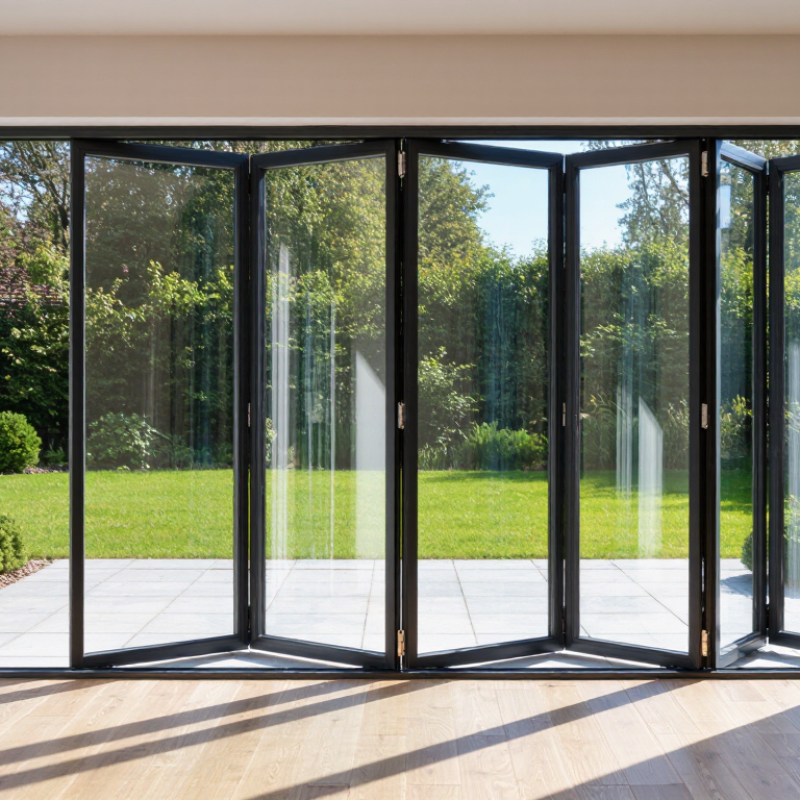
What Is a Folding Door and How Does It Work?
A folding door uses hinged panels that travel along a head track. Each panel turns, folds, and stacks beside the opening. Typical panel widths range from 600 to 1,200 millimetres. This dimension balances weight, handling, and usable opening space.
A 90° hinge lets one panel rotate to a right-angle position during folding. The track carries vertical loads, while guide rollers control movement and reduce floor friction. Wider panels can improve views, but they also increase deflection and hardware stress. Small details matter. A designer should verify panel weight, glass thickness, hinge capacity, and track alignment before selecting the final width.
Energy performance deserves attention. The U.S. Department of Energy’s 2020 Residential Energy Consumption Survey shows space conditioning uses roughly half of household energy. Poor seals can therefore weaken a folding door’s practical value. The International Energy Agency’s 2023 buildings report also places buildings at about 30% of global final energy demand. These figures do not make every folding door inefficient. They show why perimeter seals, thermal breaks, and accurate installation matter. In practice, the 600–1,200 millimetre range is useful, not sacred. Local wind loads, opening height, and daily operating frequency may require narrower leaves. I would not treat a catalog dimension as a universal rule.