

Please ensure Javascript is enabled for purposes of website accessibility

10 Coffee Pouch Packaging Tips for Global Buyers

Coffee packaging has a practical job: protect aroma, resist moisture, and arrive intact after a long journey. The International Coffee Organization’s Coffee Report and Outlook, published in December 2023, estimated global coffee consumption at 177 million 60-kilogram bags for 2023/24. That scale makes packaging choices commercially important. It does not mean every buyer needs the same pouch.

Consumer demand also keeps the category moving. The National Coffee Association’s 2024 National Coffee Data Trends report found that 67% of U.S. adults had consumed coffee the previous day. That is one country, not the whole world. Still, it signals why brands scrutinize freshness, shelf appeal, and ease of use. A Coffee Pouch must fit the coffee, the filling line, and the route to market—not just look good in a product mock-up.

Small details matter. A zipper can help consumers reseal an opened pack; a one-way valve may help release gas from freshly roasted beans. Barrier performance, seal quality, pouch dimensions, and material choices also deserve careful review. Yet a neat specification sheet cannot predict every handling condition. Humidity, heat, transport delays, and storage practices vary between markets. There is no universal pouch. This guide shares ten practical checks for global buyers, while recognizing that the right choice depends on product testing, supplier evidence, and the realities of each supply chain.
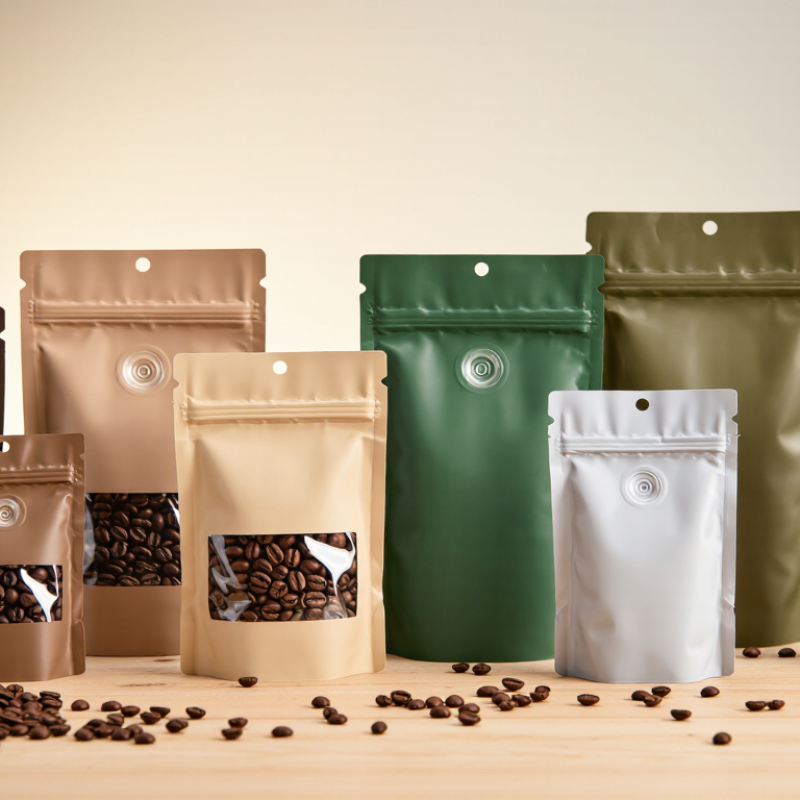
10 Coffee Pouch Packaging Tips for Global Buyers

Define Roast, Grind, and 250 g–1 kg Pack Formats by Market

Coffee preferences vary by market, so define the roast and grind before choosing a pouch size. Use clear terms such as light, medium, or dark, and state whether the coffee is whole bean or ground. Add a roast date and a concise flavor description where space allows. Small labels matter.

Grind size should match the brewing methods buyers actually use. A coarse grind may suit French press, while a finer grind may work for espresso. These terms can be interpreted differently across markets, so confirm them with local importers or roasters. Send samples before approving a large production run. A neat specification can still miss what local customers expect.

For retail, 250 g pouches can offer a manageable trial size, while 500 g may suit regular household use. One-kilogram packs often fit cafés, offices, or other higher-volume buyers, but not every market prefers them. Check shelf dimensions, expected turnover, and shipping costs alongside coffee preferences. Ask buyers to compare pack sizes with real purchasing habits, not assumptions. The first choice may be wrong; revise it using feedback.

Screen Example Barrier Targets: OTR ≤1 cm³/m²/day, WVTR ≤1 g/m²/day

For global buyers, OTR ≤1 cm³/m²/day and WVTR ≤1 g/m²/day can serve as example screening targets for coffee pouch materials. They are not universal guarantees of freshness. Results depend on test temperature, humidity, and method, so compare data measured under consistent conditions. Ask suppliers for current test reports, not just a film specification.

Tips: Check the complete pouch, including seals and any degassing valve. A high-barrier laminate can still underperform if a seal is uneven or a valve leaks. Request testing on finished pouches where possible. Small details matter. Confirm that the reported units and test conditions match your purchasing requirements.

Treat the figures as a starting point, then run storage trials with your own roast and fill weight. Keep sample pouches away from heat and sunlight, and assess aroma, flavor, and seal integrity over time. I would not treat a lab number as a promise; real shipping and storage conditions can be rough. That part is easy to underestimate.

Compare Valve Pouches, 3-Layer Laminates, and Mono-Material Films

10 Coffee Pouch Packaging Tips for Global Buyers
Compare Valve Pouches, 3-Layer Laminates, and Mono-Material Films

These options describe different packaging features, and they can overlap. A valve pouch may also use a three-layer laminate. The valve releases gas from freshly roasted coffee while limiting air entry. It can help prevent a pouch from swelling, but it does not replace a suitable barrier structure. That distinction matters. Ask suppliers for the pouch’s material composition, valve specifications, and test data.

Three-layer laminates often combine layers that protect against oxygen, moisture, light, and handling damage. Their exact performance depends on the materials and thicknesses used. Request oxygen and water-vapour transmission figures, then check that seals hold after filling and transport. Test the whole pack. A strong barrier is useful only if the pouch seals reliably. Laminates can also be difficult to recycle where local systems cannot separate or process their layers.

Mono-material films use closely related materials across the pouch structure, which may make recycling more practical in some markets. However, collection facilities and accepted formats vary by destination. Not every market agrees. Compare barrier results with those of a laminate, especially for longer shipping routes or humid storage conditions. Check seal strength, print requirements, and shelf-life targets before choosing. The lowest-material option is not automatically the best fit; sometimes the trade-off is less obvious than a spec sheet suggests.

Note: A degassing valve is a pouch feature, while “three-layer laminate” and “mono-material film” describe material constructions. These options can overlap; a valve pouch may use either type of film.
10 Coffee Pouch Packaging Tips for Global Buyers - Compare Valve Pouches, 3-Layer Laminates, and Mono-Material Films
No. Buyer Tip Valve Pouch 3-Layer Laminate Mono-Material Film What to Confirm with the Supplier
1 Match the pack to the coffee’s degassing needs. A one-way valve lets carbon dioxide escape while helping limit air ingress. It is commonly considered for freshly roasted whole-bean coffee. A laminate can be made into a valve pouch if the structure and sealing area are suitable. A mono-material pouch can also incorporate a valve, subject to film and pouch design compatibility. Ask whether the valve is required for the roast, fill date, pack size, and intended storage period; request compatibility details for the complete pouch.
2 Set barrier requirements before comparing materials. The valve does not replace the pouch’s barrier layer. The film still needs to protect coffee from oxygen, moisture, and light as required. Three layers may combine print, barrier, and sealant functions. Common constructions vary and may include metal foil or metallized film. PE- or PP-based structures can be designed with barrier layers or coatings, but performance depends on the specific construction. Request technical data for the finished structure, including oxygen and water-vapor transmission values and the test conditions used.
3 Evaluate shelf life using the actual product and pack. A valve helps manage gas release but does not, by itself, establish shelf life. Barrier performance can be strong, depending on the selected layers, thicknesses, seals, and any foil or metallized layer. Performance varies widely by resin, barrier technology, thickness, and converting process; do not assume all mono-material films perform alike. Validate shelf life with product-specific testing in the final pouch, under the intended storage and distribution conditions.
4 Check light protection for the chosen coffee format. Valve presence does not determine light protection; this is primarily a film and pouch design choice. Foil and metallized layers can provide light shielding; transparent structures generally need a separate plan if light protection is required. Opaque pigments or suitable barrier designs may help block light, but appearance and protection depend on the specification. Confirm whether the pouch is opaque or transparent and test light protection where it matters for the product and route to market.
5 Specify the seal and closure system. Verify the valve installation and pouch seals together, especially around the valve area. Seal performance depends on the inner sealant layer, sealing window, and machine settings. Ask for the recommended sealing range and confirm that the structure works with the intended filling equipment. Request seal-strength and leak-test information, and run trials on the production line using the intended pouch size and speed.
6 Choose pouch format and size around filling and use. Valve placement must leave room for artwork, seals, and the filling process. Common formats include stand-up pouches and flat-bottom bags, subject to supplier capabilities and specification. Available formats depend on the film’s stiffness, sealing behavior, and the converter’s equipment. Confirm dimensions, gussets, opening features, fill weight, headspace, and compatibility with existing filling and packing equipment.
7 Compare recyclability claims for each destination market. A valve and its attachment can affect sorting or recycling compatibility; check the complete pack, not just the film. Multi-material laminates can be difficult to separate in conventional recycling systems, though local collection and processing vary. Designed-for-recycling potential may be higher where the structure is accepted by local systems, but acceptance is not universal. Ask for the full material breakdown and market-specific recyclability evidence. Avoid treating “mono-material” as a guarantee of local recyclability.
8 Review printing and artwork requirements early. Reserve clear space for the valve and check that placement will not interfere with graphics or required information. Printed outer layers can support a broad range of graphics; confirm color control and artwork limits with the converter. Printing options depend on the film and print process; confirm ink, coating, and recycling-design requirements together. Request a dieline, print specifications, proofing process, and confirmation of required labels and language for each destination market.
9 Assess transport durability and handling. Protect the valve from crushing or damage during packing, palletizing, and transit. Layer combinations can provide useful puncture and handling properties, but the finished pack must be tested. Durability varies by film gauge and structure; a thinner design may need additional validation. Test filled packs for drops, compression, abrasion, and leakage using conditions representative of the shipping route.
10 Compare total landed cost, not film price alone. Include valve, placement, inspection, and any extra handling in the cost comparison. Compare the complete pouch specification, print, conversion, and freight rather than material cost alone. Consider qualification, line adjustments, local recycling requirements, and any impact on pouch thickness or shipping weight. Request quotations on the same dimensions, material performance, print coverage, order quantity, delivery terms, and testing scope.

Check Food-Contact Rules: EU 1935/2004, EU 10/2011, and FDA 21 CFR

A coffee pouch can look simple, yet its food-contact layers may include plastic films, inks, and adhesives. Under EU Regulation 1935/2004, materials must not transfer substances to food in amounts that could endanger health or unacceptably change its composition, taste, or smell. For plastic layers, EU Regulation 10/2011 sets an overall migration limit of 10 mg per square decimetre, alongside substance-specific limits. That figure is not a universal pass mark for every pouch component.

Check the exact structure and intended use. A pouch holding roasted beans may face different contact conditions from one holding oily, flavored coffee. Ask suppliers for declarations of compliance, supporting migration-test reports, and details on test conditions. For the United States, review the relevant FDA rules in 21 CFR, including applicable sections in Parts 174–178. FDA compliance depends on the substance, use, and conditions—not simply on a “food-grade” label. Details matter.

Test the finished laminate when possible, not just an individual film. Heat-seal layers, inks, and adhesives can affect the final structure, and a certificate may not cover every conversion process. I have seen paperwork look tidy while leaving the intended use unclear. That deserves a second look. Cite the applicable EU regulations and FDA provisions in purchase specifications, then confirm that the documents match the pouch you will actually order.

Validate OTR and WVTR with ASTM D3985 and ASTM F1249 Tests

For coffee pouches, oxygen and moisture barrier claims need measured evidence. ASTM D3985 measures oxygen transmission rate (OTR) through a material under specified test conditions. ASTM F1249 measures water vapor transmission rate (WVTR). These values help buyers compare laminate structures, but only when the conditions match.

Ask the laboratory to report temperature, relative humidity, specimen thickness, test area, and units. These details matter. A film tested at one humidity may perform differently in a humid warehouse. Request repeat measurements when results are close to your specification. Small variations can change a purchasing decision.

Test the actual laminate, not just a single layer. A flat-film result cannot reveal a weak zipper, pinhole, or corner seal. That gap is easy to overlook. Set clear OTR and WVTR limits with your supplier, then verify samples from production. Barrier testing will not predict every storage condition, and it is not a substitute for checking seals or running a coffee shelf-life study. Even a tidy data sheet can leave questions. Check that the tested structure matches the pouch you plan to order.